India’s industries are growing fast, and materials that combine strength, lightness, and excellent conductivity sit at the heart of this progress. Aluminium wire rods play a quiet but vital role in power lines, cables, motors, and countless everyday products. When engineers and project leaders look for reliable sources, they naturally turn to experienced producers who deliver consistent quality batch after batch. High-performance versions stand out because they meet strict electrical and mechanical demands while remaining cost-effective and easy to work with.
These rods start as high-purity aluminium and go through careful processing to achieve the right diameter, surface finish, and temper. The result is a material that carries electricity efficiently, resists corrosion in tough environments, and stays strong under repeated stress. In a country building new transmission networks, expanding renewable energy, and modernising manufacturing, the demand for such rods keeps rising steadily.
Aluminium wire rod manufacturers in India understand these needs deeply. They invest in modern equipment, trained teams, and thorough testing so every coil that leaves the factory performs exactly as promised. The best producers also offer flexibility—different sizes, tempers, and packaging—to match specific project requirements without delay.
What Makes Aluminium Wire Rods So Valuable
Aluminium itself is a remarkable metal. It is only about one-third the weight of copper yet offers good conductivity when produced to electrical-conductor (EC) grade. A thin natural oxide layer protects it from rust, making it ideal for outdoor use. Manufacturers shape the metal into smooth, uniform rods that can be drawn further into fine wires or used directly in conductors.
High-performance rods go beyond basic purity. They show excellent ductility, which means they bend and stretch without cracking during installation or service. Their surface stays clean and free from defects, so downstream processes like stranding or insulation run smoothly. Consistent diameter across long lengths prevents weak spots and ensures stable electrical resistance. These qualities matter most in long-distance power transmission, where even small efficiency improvements save huge amounts of energy over time.
The Role of Aluminium Wire Rods in Modern Industries
Power utilities rely on these rods to create lightweight overhead conductors that span rivers and hills with less sag and lower tower costs. In urban distribution networks, the rods help build compact cables that fit neatly into crowded ducts. Transformer manufacturers wind them into coils where low weight reduces transport expenses and eases assembly.
Construction companies use aluminium rods in earthing systems, lightning protection, and building wiring. The rods also appear in automotive wiring harnesses, where every kilogram saved improves fuel efficiency. Appliance makers turn them into heating elements and motor windings because the material handles repeated heating and cooling cycles reliably.
Even smaller sectors benefit. Food packaging lines use fine-drawn wires from these rods, while engineering workshops rely on them for cold-heading and weaving applications. The versatility comes from the careful balance of strength, conductivity, and formability that only high-performance rods deliver.
Qualities That Define High-Performance Aluminium Wire Rods
Industry experts look for several clear markers. First, the metal must come from EC-grade aluminium with a minimum 99.5 % purity. This level keeps electrical conductivity high—typically above 61 % IACS in finished rods. Second, mechanical properties matter: tensile strength, elongation, and fatigue resistance must stay within tight tolerances so the rod survives handling and long-term vibration.
Surface quality is equally important. Smooth, bright rods reduce the risk of insulation damage and improve contact in joints. Diameter tolerance of just a few microns across hundreds of metres shows true manufacturing control. Finally, the rods must arrive in the right temper—hard drawn for maximum strength, half-hard for balanced properties, or fully annealed for easy forming.
When all these factors align, the rods earn the label “high-performance.” Projects finish on time, systems run efficiently for decades, and maintenance stays low.
Ganpati Engineering Industries: A Trusted Name in Quality Production
In the middle of India’s aluminium wire rod landscape stands a company that has quietly built a strong reputation over nearly five decades. Ganpati Engineering Industries began operations in 1977 from its facility in Jaipur, Rajasthan. Today, the plant covers modern infrastructure on its own land and focuses on delivering metallic wires and rods that meet exacting customer needs.
The company works with EC-grade aluminium to produce both wires and rods in a wide range of sizes. Round rods range from 1.6 mm to 15 mm, while wires can be drawn as fine as 0.08 mm up to 20 mm. Customers choose hard-drawn, half-hard, or annealed conditions depending on the final application. Every batch goes through rigorous checks in a well-equipped laboratory that includes a spectrometer for composition analysis and machines that measure tensile strength, elongation, and conductivity.
Ganpati holds ISO 9001:2015 certification along with ROHS compliance, MSME registration, and RCMC. The products also carry approvals from respected organisations such as PWD, BHEL, and PVVNL. These credentials reflect years of consistent performance rather than marketing claims.
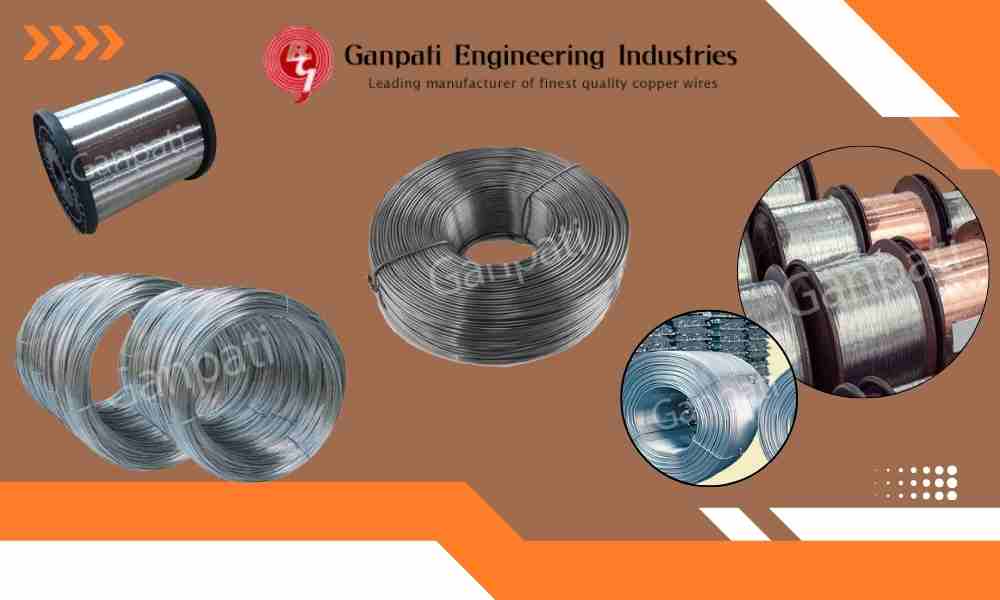
As a Bare Aluminium Rod Manufacturer, Ganpati Engineering Industries pays special attention to surface finish and dimensional accuracy. The bare rods leave the plant clean, free from burrs or oxidation spots. Ready for immediate use in stranding machines or redraw processes. Coil weights are kept practical—typically between 250 kg and 2000 kg—so customers can handle them safely and feed production lines without frequent stops.
Acting as a dependable Bare Aluminium Rod Supplier, the company ships across India and supports clients with custom lengths, special packaging, and prompt delivery. Whether the order is for power-cable conductors, transformer windings, or industrial hardware, the rods arrive exactly as specified. Engineers who have worked with Ganpati often mention the reliable conductivity values (60–61.5 % IACS for alloy grades) and the mechanical range (8.5–13.6 kg/mm² tensile strength) that match or exceed international benchmarks such as DIN, ASTM, BS, and JS.
The team at Ganpati combines experienced technicians with modern drawing and annealing equipment. This blend ensures every rod performs uniformly from the first metre to the last. Clients in the cable industry appreciate how the rods reduce breakage during high-speed stranding. Motor manufacturers value the annealed versions that wind tightly without spring-back. The result is smoother production and fewer rejects—benefits that matter in today’s competitive markets.
How High-Quality Rods Are Produced
The journey from raw aluminium to finished rod follows several carefully controlled steps. It begins with the selection of prime EC-grade ingots or proper molten metal. The material is melted under strict temperature control to avoid unwanted impurities. Next comes casting—either continuous or in controlled moulds—to form initial billets of the right size.
These billets then enter a rolling mill where they are reduced step by step into the target rod diameter. Each pass through the rolls is monitored so the metal flows evenly and the grain structure stays uniform. After rolling, the rods may be drawn further through precision dies to reach finer sizes or exact tolerances.
Annealing follows in specially designed furnaces. The temperature and cooling rate are adjusted to achieve the desired temper—hard for strength or soft for flexibility. Throughout the process, samples are taken at every stage for laboratory testing. Conductivity, tensile strength, elongation on a 250 mm gauge length, and visual surface inspection all must pass before the coil receives final approval.
Advanced producers like Ganpati also perform final cleaning and protective packaging so the rods reach customers in perfect condition. This complete chain—from raw material to finished product—guarantees the high performance that modern projects demand.
Why Indian Manufacturers Excel in This Field
India enjoys several natural advantages. Access to quality aluminium, a skilled workforce trained in metallurgy, and continuous investment in technology have helped local producers match global standards. Indian manufacturers often respond faster to custom orders because they understand local project conditions—hot climates, monsoon humidity, and varying voltage requirements.
Cost competitiveness is another clear benefit. When quality stays high and overheads remain reasonable, customers receive excellent value. Many Indian producers also follow sustainable practices, recycling process scrap and minimising energy use during melting and annealing. The combination of technical capability, responsive service, and responsible manufacturing makes India a preferred source for high-performance aluminium wire rods.
Choosing the Right Supplier for Long-Term Success
Project teams look for more than just a price list. They want a partner who can supply consistent quality month after month. Offer technical advice when specifications change, and keep lead times short. A supplier with in-house testing, experienced staff, and a track record of approvals gives confidence that every delivery will support smooth operations.
Ganpati Engineering Industries demonstrates these qualities daily. Their focus on EC-grade material, precise sizing, and multiple tempers. And thorough documentation helps clients meet their own quality targets without extra effort. Whether the requirement is standard 9.5 mm rods for conductors or special sizes for niche applications, the company delivers reliably.
Conclusion
High-performance aluminium wire rods have become essential building blocks for India’s infrastructure and manufacturing growth. Their combination of light weight, good conductivity, corrosion resistance, and workability solves real engineering challenges across power, construction, transport, and consumer goods sectors.
When industries seek dependable sources, they find that experienced aluminium wire rod manufacturers in India continue to raise the bar through modern facilities, strict quality control, and customer-focused service. Companies such as Ganpati Engineering Industries, recognised as a reliable Bare Aluminium Rod Supplier, show how local expertise can meet global expectations. Their EC-grade bare rods, available in a full range of sizes and tempers, help projects finish successfully and operate efficiently for years.
As India moves toward stronger power networks, greener energy, and smarter manufacturing, the importance of these rods will only increase. Choosing a proven manufacturer ensures that every metre of rod contributes to reliable performance and long-term value. The future of electrical and industrial applications in the country looks bright—supported quietly but powerfully by high-performance aluminium wire rods made right here in India.